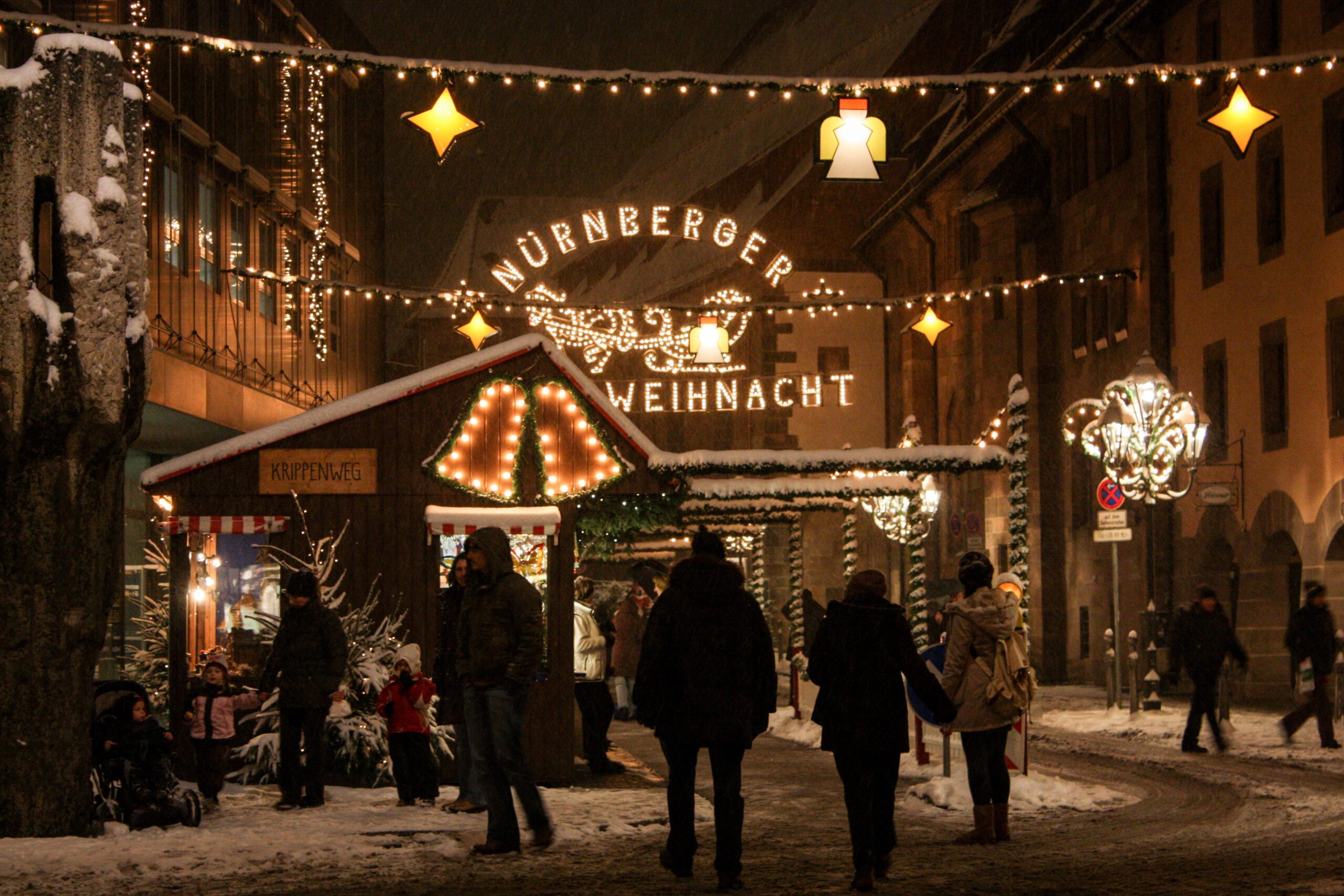
Cold hands. A hot mug. Charcoal smoke rolling off a sausage grill, cut with the burnt-sugar smell of almonds tumbling in a copper kettle or chestnuts roasting on an open fire over old barrels. Every wooden hut in the square is selling German Christmas market food, and you’ve only got one stomach.
That’s a German Christmas market. The ornaments are nice. The food is the reason you came.
We cooked German food for a living for years at Brauhaus Schmitz in Philadelphia, wrote a cookbook about it, and now live in Germany, where Christmas market season is less a holiday tradition than a five-week eating schedule. This is our short list of German Christmas market food that’s worth the cold, the line and the mug deposit. Plus a few things we walk right past.
How Eating at a German Christmas Market Works
A few things nobody tells first-timers:
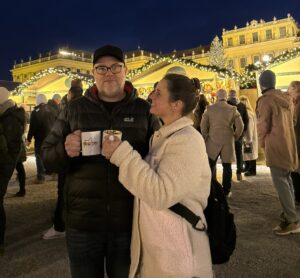
- You pay a deposit on your mug. Glühwein, Punsch, and all hot drinks comes in a ceramic mug, and a Pfand (deposit) of a few euros is added to the price. Bring the mug back and you get the deposit back. Or keep it. Many markets print a new design every year, and it’s a better souvenir than most of what’s sold in the gift huts. Don’t buy the mug at the souvenir stand. It’s more expensive than just keeping the mug from the hut!
- Carry cash. More stands take cards every year. Not all of them, and not always when the line is twenty deep.
- You eat standing up. Look for the tall tables (Stehtische) near the drink stands. Share them. That’s half the fun. Or depending on what you get, you can walk with it and eat. Sausage sandwiches are perfect for this!
- Go hungry, eat small. One thing per stand, split it, keep moving. The rookie mistake is a full plate of something in the first ten minutes. We try everything and share it all.
- Weekday afternoons are your friend. Evenings and weekends get shoulder to shoulder, especially in Nürnberg and Munich. Our tip is get there before the sun sets, late afternoon and be there as it gets dark and the markets really light up.
The Savory Side of German Christmas Market Food
Bratwurst (and which one to order)
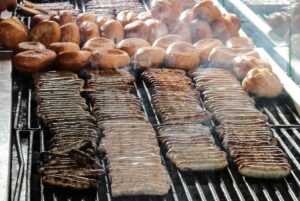
Every market grills sausages. The question is which. In Nürnberg, order Drei im Weggla: three little Nürnberger Rostbratwürste tucked into a roll with mustard. They’re finger-length, pork, heavy on marjoram, and the recipe goes back centuries. The name is protected by the EU, so a real Nürnberger has to come from Nürnberg.
Elsewhere you’ll find longer, coarser grilling sausages, and plenty of stands selling the long Thüringer. Get yours in a Semmel (roll) with sharp mustard. Ketchup is between you and your conscience. If you’d rather make your own, here’s our homemade Bratwurst recipe on New German Cooking, the recipe site for our cookbook.
Kartoffelpuffer (Reiberdatschi)
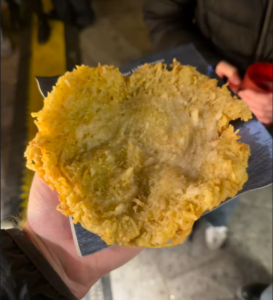
Grated potato and onion, fried in shallow fat until the edges go lacy and brown. Most of Germany calls them Kartoffelpuffer. In Bavaria they’re Reiberdatschi. A lot of people eat them with applesauce, and that’s a valid way to eat them, but we prefer the savory version. Many stands brush them with garlic oil or serve them topped with sour cream, cheese, and bacon. Either way is great. Try them both and see for yourself. Sweet and savory together sounds strange until the first bite, and then you’ll wonder why nobody told you sooner. Here’s our recipe for Kartoffelpuffer if you want them crisp at home.
Schupfnudeln with Sauerkraut
Hand-rolled, finger-shaped potato dumplings browned in a huge flat pan with sauerkraut, often with bits of bacon. Peasant food in the best sense of the word. The pieces that have been sitting against the hot steel and gone crisp are the ones you want. Don’t be shy about pointing.
Creamy Mushrooms
Button mushrooms, pan roasted until golden brown and served with a garlicky sour cream sauce, ladled into a paper boat. These are a hit all over. Simple, rich, and exactly what a cold night calls for. At home, we make our Christmas market mushrooms, finished with a garlicky sour cream sauce. If you can’t make it to the markets this year, you can recreate the food at home with some of these recipes.
Raclette Bread
A half wheel of Alpine cheese under a heating element, scraped in a molten sheet over bread, often with onions or pickles. You’ve probably seen this. It’s been all over social media for a few years. The dramatic blistered cheese wheel melting onto baguettes or potatoes. You can smell it before you get to the huts. Some people love it, some hate it. Like most great cheeses it definitely tastes better than it smells. Strictly speaking it’s Swiss. In practice it’s at nearly every market in southern Germany and Austria, and the line is long for a reason.
Flammkuchen
Flammkuchen is a thin, crackling flatbread with crème fraîche, onions and bacon from Alsace and the German southwest. It’s served all over southern Germany as well. Get the classic and you can’t go wrong.
Lángos
Lángos is Hungarian fried dough rubbed with garlic and piled with sour cream and cheese. Neither is Bavarian. Both are everywhere, and both taste great after your second Glühwein. We’re not purists about it. If you’re anything like us and like fried dough, you’ll love it.
Sweet German Christmas Market Food
Lebkuchen (Look for Elisen)
Gingerbread is one of Germany’s most famous export of baked goods, and Nürnberg is its capital. The big iced hearts on ribbons are more souvenir than snack. What you want is Elisenlebkuchen. Under German food guidelines they have to be at least 25 percent almonds, hazelnuts or walnuts, with no more than 10 percent flour. That’s why the good ones are soft, dense and taste like toasted nuts and spice instead of sweet cardboard. Buy a tin to take home. They keep. Elisen are tricky in a home kitchen, so when we bake, we make a simpler, glazed cookie: our Lebkuchen recipe from New German Cooking.
Gebrannte Mandeln
Almonds roasted with sugar and cinnamon in a copper kettle until the coating crusts and crackles. It’s the first smell that hits you at almost every market. Buy them warm. A small cone is plenty, and you’ll still finish it.
Heiße Maroni
Roasted chestnuts in a paper cone. Sweet, a little smoky, slightly mealy, and they double as hand warmers. Peel and eat while you walk.
Stollen
Dense yeasted bread loaded with butter, dried fruit and candied peel, buried under powdered sugar. Dresden’s is the famous one. Our advice: skip the slice at the market and buy a whole loaf to take home. It keeps for weeks and gets better as it sits.
Bratapfel, Dampfnudel and Fried Dough
- Bratapfel: a baked apple stuffed with marzipan, nuts and raisins, swimming in vanilla sauce.
- Dampfnudel: a big steamed yeast dumpling with vanilla sauce. The best ones have a caramelized, crunchy bottom.
- Schmalzkuchen and Auszogne: fried dough, dusted with powdered sugar. Bavaria’s Auszogne are stretched thin in the middle and puffy at the edge.
- Baumstriezel or Trdelnik: a spiral of dough wrapped around a spit, roasted over coals and rolled in cinnamon sugar. Its roots are in Hungary and Transylvania. Pull it apart while it’s still steaming.
What to Drink
- Glühwein: hot spiced wine, usually red. Try the white version (weißer Glühwein) at least once. Order it “mit Schuss” and you get a shot of rum or amaretto in it. If a stand pours Winzerglühwein, made by a winery from its own wine, pay the extra euro. At the big Bavarian markets, expect to pay roughly €4 to €6 a mug in recent seasons, plus the deposit. To make it at home, here’s our Glühwein recipe.
- Beerenpunsch: warm, boozy berry punch, with macerated berries floating in it. One of our favorites.
- Feuerzangenbowle: a rum-soaked sugar cone set on fire over a vat of mulled wine. Half drink, half show.
- Eierpunsch: warm, boozy egg punch, usually with whipped cream on top. Think eggnog’s German cousin.
- Jagertee: black tea spiked with rum and spices. You’ll see it more in Austria, so look for it in Salzburg.
- Kinderpunsch: the alcohol-free fruit punch. Not just for kids, and nobody will judge you.
What We Skip
- Anything under a heat lamp. If it was cooked an hour ago, it tastes like it.
- Food you can get anywhere. Generic crêpes, churros and fries are fine. They’re also the same in every city on earth. You didn’t fly to Bavaria for them.
- The first stand by the entrance. Walk a lap first. The best stands usually have a line of locals, not a line of tour groups.
German Christmas Market Food by City
- Nürnberg: The Christkindlesmarkt is the place for Drei im Weggla, Elisenlebkuchen, and a look at the Zwetschgenmännla, little figures made from dried prunes and figs that are a Nürnberg Christmas tradition.
- Munich: Reiberdatschi, Schupfnudeln, and an afternoon detour through the Viktualienmarkt. If you want a sit-down dinner after the markets, here are our favorite Bavarian restaurants in Munich.
- Salzburg: raclette bread, a hot punch or Jagertee, and a front-row spot for the Krampus run on December 5.
- Passau: a smaller, calmer market in front of the cathedral, plus a city that’s worth a full day. Here’s our guide to Passau.
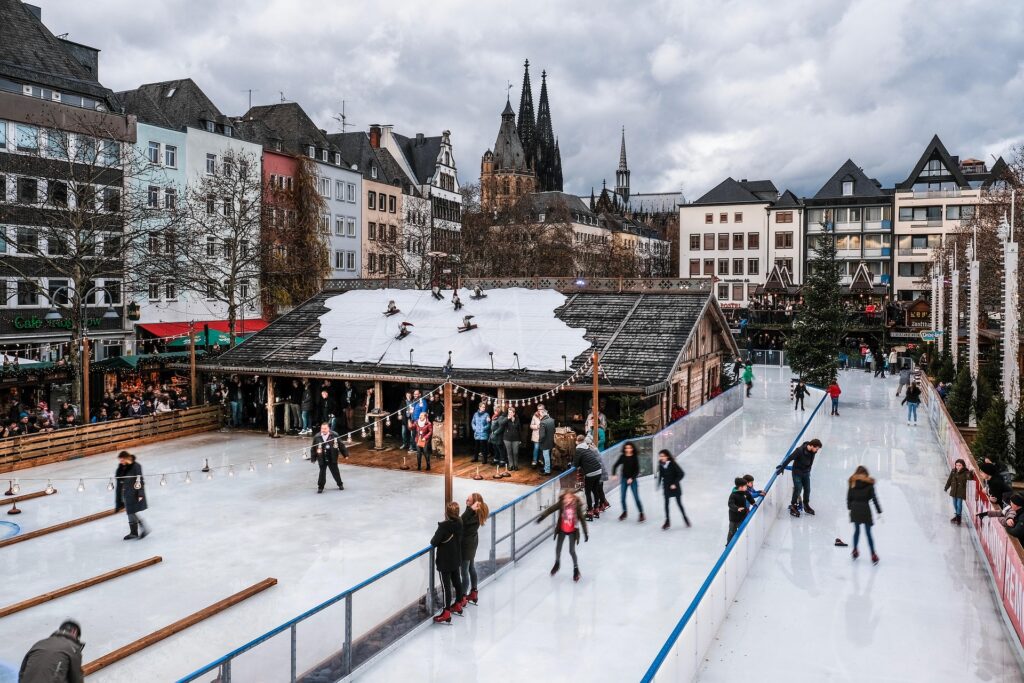
- Köln: Rievkooche, the Kölsch-dialect name for Reibekuchen, the Rhineland’s take on potato pancakes, eaten with applesauce or on dark bread. Wash them down with a glass of Kölsch, the city’s own beer, which the markets pour alongside the Glühwein.
Planning which markets to visit? Start with our guide to Bavarian Christmas markets, with this season’s dates.
FAQ About German Christmas Market Food
What is the most popular German Christmas market food?
Bratwurst and Glühwein, with gebrannte Mandeln, Lebkuchen and potato pancakes close behind.
Do German Christmas markets take credit cards?
More and more stands do, but not all. Carry cash, especially small bills and coins.
Can I keep my Glühwein mug?
Yes. You just don’t get your deposit back. Plenty of people collect them.
Is there vegetarian food at German Christmas markets?
Lots. Potato pancakes, creamy mushrooms, raclette, Lángos, Flammkuchen without bacon, Schupfnudeln (ask about the bacon), and almost everything sweet.
Eat Your Way Through the Markets With Us
From December 3 to 10, 2027, we’re taking a small group of no more than 17 travelers through the Christmas markets of Munich, Salzburg, Passau and Nürnberg. We’ll bake apple strudel and cookies in Salzburg, watch the Krampus come out, and sit down to a Christmas goose dinner on the Danube. You get two chefs pointing you to the right stands, and a signed copy of our cookbook, New German Cooking, to take home.
See the Bavarian Christmas Market Tour 2027
Missing the markets once you’re home? Start with our 15 favorite German Christmas recipes on New German Cooking.
What’s the one thing you always eat at a Christmas market? Tell us in the comments. We’re always looking for the next stand to try.